1879 - 1909
JAPANESE AMERICAN'S SUCCESS IN AGRICULTURE
Just as the Japanese were arriving in the United States, the development of irrigation in California opened the way for intensive agriculture and a shift from grain to fruit and vegetable production. Between 1879 and 1909, the value of crops from intensive agriculture skyrocketed from just 4 percent to 50 percent of all crops grown in California. This transformation occurred under a market stimulus created by two key technological achievements of the period-the completion of the national railroad lines and the invention of the refrigerated car. Consequently, for the first time perishable fruit and vegetables from California could be sold almost anywhere in the United States.
Japanese farmers were able to capitalize on these developments. As early as 1910 they produced 70 percent of California's strawberries, and by 1940 they grew 95 percent of fresh snap beans, 67 percent of fresh tomatoes, and 95 percent of the celery. In 1900, California's Japanese farmers owned or leased twenty-nine farms totaling 4,698 acres; five years later the acreage jumped to 61,858; and by 1910 it reached 194,742 acres. Even the California Alien Land Law of 1913, which prohibited "aliens ineligible to citizenship" from owning land or leasing it for more than three years failed to stem this trend.
By 1920 Japanese farmers owned or leased 458,056 acres. Despite protests from Japan, a U.S. ally in the First World War, a California initiative passed in 1920 closed the loopholes in the 1913 act, and Japanese landholdings dropped dramatically.
1879
RACISM IN TUCSON ARIZONA & CHALLENGING ANTI-CHINESE LEGISLATION
The Arizona
Weekly Star ran an editorial in 1879 portraying them as " an ignorant,
filthy, leprous horde." The Tucson paper, El Fronterizo, described the
Chinese in 1892 as "the most pernicious and degraded race on the globe,"
and in 1894 as "a fungus that lives in isolation, sucking the sap of the
other plants." This racism, and the fear of having to compete with Chinese
workers for jobs, eventually led Anglo and Mexican laborers to violence.
Chinese workers were attacked in railroad camps and mining towns. Instead
of taking a stand against prejudice, the railroad and mine managers chose
to phase-out Chinese laborers as a "solution" to the violence and unrest.
By the early 20th century, the Chinese
had been driven out of Arizona's mines and railroads.
An
editorial in The
Santa Cruz Sentinel in 1879, for example, described the Chinese
as "half-human, half-devil, rat-eating, rag-wearing, law-ignoring,
Christian-civilization-hating, opium-smoking, labor-degrading, entrail-sucking
Celestials."
Another
California newspaper, The
Dutch Flat Forum, struck a similar chord at the time. "Women
of California," it asked, "why do you persist in having
your dirty linen fouled by unclean hands, under the pretense of having
it cleansed? Do you not know that (in these exciting times when the Chinese
are losing employment, and naturally mad at the white race) you are taking
desperate chances of having disease introduced among us that will render
desolate our firesides? And in fact we don't know but that the diseases
among our children
during the past year, which have baffled the skill of our most eminent
physicians, and depopulated many households, have emanated from the Chinese."
While Chinese immigrants fared better in Arizona Territory than elsewhere in the West, anti-Chinese feeling occasionally manifested itself in violence and threats of removal. More often, it ook the form of laws restricting the activities of Chinese residents. Territorial criminal court records indicate that as Arizona's Chinese population grew in the late 1870s and 1880s, new laws regulating laundries and opium dens brought more and more Chinese before the judicial bench. Many of these cases resulted in judgments against the defendants.
At the same time, Arizona's Chinese were hardly passive wayfarers in the courts. They hired attorneys to apply the law in their favor. If the Chinese had not challenged their arrests, very few cases involving anti-Chinese discrimination would exist in county superior court records. Many of these briefs appealed lower court rulings involving violations of opium laws, while a few challenged verdicts in assault and petit larceny cases. In some of these appeals, Chinese defendants directly assailed opium ordinances, laundry licensing, and other discriminatory laws, or objected to the discriminatory enforcement of such seemingly unbiased laws as selling cigarettes to minors. In doing so, they also challenged prejudice in late-nineteenth-century America.
Arizona Territory escaped most of the hysteria of the 1850s and 1860s that produced the foreign miner's tax in California and Idaho's monthly head tax, enacted specifically to discourage Chinese immigration. Following complaints about overcrowding, stench, disease, fire hazards, prostitution, and gambling in Chinatowns, California
communities passed ordinances regulating Chinese laundries and limiting
the number of residents in a dwelling.
Chinese laundries were a common source of complaint
in many cities and towns throughout the West. Where racial hostility
often barred Chinese from mining and manufacturing, many immigrants
were forced to take the only jobs that remained - in restaurants,
vegetable farming, laundries, and other service occupations. Ironically,
whites who often benefitted from these services, particularly if no
one else was willing to take the positions, became alarmed that the
Chinese were taking away jobs and money. Prescott and Phoenix newspapers
condemned the Chinese monopoly on laundries. They suggested that enterprising
whites should open their own establishments in order to promote competition
and, also, to discourage immigration.
For some whites, Chinese laundries were more than
just an economic threat, they also endangered public health. Territorial
newspapers frequently denounced washhouses as "public nuisances,"
where the "filthy practices of the Chinese in allowing pools of dirty
and stinking water to accumulate around their laundries produce breeding
places of disease which it is most wise to guard against." An 1896
article in the Tempe News lashed out against "the cesspools of Chinese
washhouses," and described "the stench that arises from these places"
as "something awful." Local governments responded to these complaints
by enacting ordinances that regulated laundries as potential health
hazards. "The action of the Common Council of Phoenix in declaring
all wash houses in the city limits public nuisances, is commendable,"
the Arizona Gazette noted in 1881.
In Arizona and elsewhere, the Chinese followed a
longstanding tradition of defending their civil rights. Ho Ah Kow
v. Nunan , an 1870s California test case, established two important
grounds for challenging anti-Chinese legislation:
- 1) that the Fourteenth
Amendment applied equally to citizens and non-citizens; and
- 2) that,
in rendering a verdict, courts could consider the motivation behind
passage of a law.
 |
1879
AH LUM / QUONG GEE KEE / "CHINA MARY" / TOMBSTONE'S CAN CAN RESTAURANT / HOPTOWN
Ah Lum (along with "China Mary" - his wife) and Quong Gee Kee owned one of the most famous eateries in Tombstone, Arizona - the stomping grounds of Wyatt Earp and his OK Corral gang - the
Can Can Restaurant.
Quong Gee Kee
As a long time resident of Tombstone, he knew all of the infamous characters from the 1880's era, some who ate at Can-Can. "Wyatt Earp was a nice fellow," Quong had said. "Lot of times he was hard on other people. Sometimes he would shoot them up." Quong also knew Billy Clanton. "Nice boy, always paid his bills. Too bad he got shot down at the O.K. Corral."
Presumably from Hong Kong, Quong's first job in America was as a cook's helper in Virginia City, Montana. When Virginia City became a ghost town, he opened a restaurant in Stockton, California, saving his money to return to Hong Kong. He made the trip back to Hong Kong where he got married and bought a home. Eight months later he left his pregnant wife to return to America. Quong planned to earn enough money to take back to Hong Kong to comfortably support his family. Once back in America,
Quong ran a prosperous restaurant in Wilcox, Arizona called "Hindquarter." Then Quong was lured to the new boom town, Tombstone.
ARIZONA HISTORY
Construction
of a transcontinental
railroad through Arizona brought in hundreds of Chinese construction
workers. By the time the railroad was completed in 1880, the Chinese
had settled into nearby towns. They were attracted to Tombstone's
silver boom and worked there as cooks, servants, launderers, gardeners,
woodcutters and charcoal manufacturers. Between 1879 and 1886,
500 to 800
Chinese lived in Tombstone.
Whites, or "round eyes," opposed the Chinese.
On July 24, 1880, the first anti-Chinese meeting was held.
Adversaries proclaimed "John Chinaman Must Go!" and threatened
to use violence. But the Chinese refused to leave and, fortunately,
no action was taken - even though, at one time, the Tombstone's
Bird Cage Theatre staged a burlesque play, "The
Chinese Must Go."
Although the white settlers frowned on the Chinese'
strong cultural ties and apparent opium use and gambling, they
abhorred them for not supporting the local economy. Chinese seldom
patronized town businesses, imported their clothing and food from
China and monopolized services by charging menial wages. When
silver mining operations curtailed in 1886, most Chinese
left Tombstone to seek jobs elsewhere.
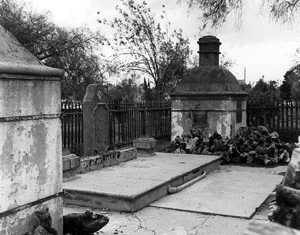
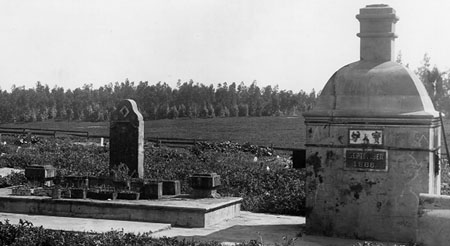
Aside from the graves, few remnants of the once-thriving Chinese
community in Tombstone exist today. Big Nose Kate's Saloon
has a preserved front page article from the Tombstone Epitaph
of Quong's funeral. Every October Tombstone's "Helldorado" commemorates
the shooting at the O.K. Corral with re-enactments of various
gun battles. One scene portrays an outlaw named Rook who refused
to pay for his meal at a Chinese restaurant, then severely beat
up the proprietor. The unidentified Chinese grabbed a gun and
shot and killed Rook, in the only known incident of a Chinese
shootout in Tombstone. |
Like the other
Chinese, he wasn't interested in shootouts and gun battles.
Quong was notoriously kind to his customers. When five rowdy cowboys rustled up the restaurant (wild after months of isolation on the range tore up the restuarant,
Quong chose not to have them arrested - ignoring the advice of his friends. "They'll come back and pay up," he inferred. "If I arrest them, I'll lose five friends and good customers." A week later a shamefaced cowboy approached
Quong. "We acted like a bunch of fools," the cowboy said. "Me and the boys would like to pay you for busting up the place."
When the mines went bust and Tombstone became a ghost town, Quong's restaurants in Pearce, Charleston and Tombstone closed. People owed Quong money from doing business at the Can Can Restaurant and his two other restaurants out of town. Because of his generous nature, he had more money on the books than in the registers, but he still refused to sue people who owed him money because, as he put it, it would only make the lawyers rich and lose him friends.
Only a few Chinese like Quong Gee Kee remained after 1886 when the mining operations ended. During his final years, Quong rambled the streets of Tombstone. Sadly, he gave up any hopes of returning to Hong Kong. He never saw his son.
In January, 1938,
Quong was found unconscious on the floor of his home by Marshal Hal Smith. He was rushed to the hospital in Douglas where
he passed away early the next morning. For some unknown reason
his body was rushed to Bisbee where it was buried in a pauper's grave in the Evergreen Cemetery.
Despite all his friends, Quong died penniless. But since he was such a well-liked figure in Tombstone, his friends collected a sizeable fund to bury him in style at the historic Boothill Cemetery right next to China Mary (as he had requested) where some 500 people showed up for his burial. Since Quong always claimed to be 10 years younger than he was, when he died in 1938 at age 86 - he might have really been 96. Quong was Tombstone's last Chinese resident. His funeral at Boothill was the first since China Mary died in 1906.
MRS. AH LUM / CHINA MARY
Tombstone's China Town was run by Mrs. Ah Lum, "China Mary", who, as her grave marker reads, was "Born in China, Died in Tombstone Dec. 6, 1906, Aged 67 Years." As many as 500 Chinese lived in Tombstone, operating businesses and working in the mines following their release from railroad construction in the 1870s.
China Mary arrived in Tombstone in late 1879 or early 1880. She was a woman of copious frame who wore heavy brocaded silks and rare jewelry. Ah Lum's wife, known as China Mary, was the official queen of Tombstone's Chinatown - which at one point had upwards of 500 people. She had connections to China, imported opium, kept a stable of servants who were guaranteed not to steal, and took in the injured, poor and down-and-out.
TOMBSTONE INFO
Tombstone
was founded by a immigrant prospector, Edward L. Schieffelin,
who set out from Fort Huachuca in 1879. Having been warned he
would find "nothing else but his tombstone," he discovered silver
ore and named the site Tombstone. Mining accelerated in 1887,
one year after Geronimo's surrender. Tombstone became a mining
boomtown with a population of more than 5,000 fortune seekers.
110 liquor licenses were issued in 1892 and Tombstone quickly
became the place of Western folklore and fact. Several historic
buildings still stand, including the Crystal Palace Saloon and
the Bird Cage Theater, it's walls riddled with 140 bullet holes.
Tombstone is most known for it's notorious residents, legends
such as John Heath and Wyatt Earp. |
Nobody knew her real name or where she was from in China.
She married Ah Lum - co-owner of the Can-Can Restaurant with Quong Kee ("Worshipful Master of the Chinese Masonic Lodge") and the two forged power in Tombstone's Chinese sector, which the round eyes called Hoptown. China Mary provided houseboys, servants, maids, launderers, gardeners, cooks and, allegedly, prostitutes or slaves. Only through "China Mary" could townspeople hire a Chinese. She often helped the sick, injured and hungry and even loaned money to strangers who seemed honest. Once
she paid for an injured cowboy's medical bills.
Few women in the American West had as much dignity as China Mary had during that time. Her decisions went undisputed and nobody dared to disobey her. No Chinese could be hired except through China Mary; none could be paid: except through China Mary. She also controlled Chinese prostitution and all the opium trade in town. She owned an interest in most Chinese businesses in Tombstone, too. Many believe that the Six Companies sent her there to oversee things and that her marriage to Ah Lum might have been political.
China Mary kept a well-stocked store of Chinese delicacies and art. She apparently ran a gambling operation in hidden rooms and supplied opium to Tombstone dens. A wild and impulsive person, once she dashed off to Tucson with the local blacksmith and was brought back to Tombstone by a cowboy her husband hired. Another time she and two tramps were arrested and jailed for theft and possession of stolen property. China Mary, with her connections in China, imported opium, kept a stable of servants who were guaranteed not to steal, and took in the injured, poor and down-and-out.
Despite that she was Chinese, her shady operations and quirky character - town folk respected and liked China Mary. She would lend money to anyone who impressed her as honest and hard working. No sick, injured or hungry person was ever turned from her door. She once took a cowboy with a broken leg to the Grand Central Boarding House and paid the bill until he recovered.
AFTER TOMBSTONE, CHINESE NOT TOLERATED IN
BISBEE
When the mining operation in Tombstone
ceased in 1886, the obvious choice for the Chinese was to go to
nearby Bisbee, where copper mining flourished. But they were not
welcomed there. Chinese could sell produce in Bisbee during the
day, but by sundown they had to skip town. A county judge passed
an unwritten law forbidding Chinese
from staying overnight in Bisbee. The exclusion was to prevent
competition with local laundresses, most of them miners' widows
who started laundry businesses to support themselves.
But it was a petty reason to exclude the Chinese.
Bisbee was a white man's mining camp, giving preference to Anglos,
many of them Europeans. Even Mexicans were underpaid and could
not work in the mines. Chinese
were at the bottom of the pecking order, enduring harsh discrimination.
|
She was the absolute ruler of
"Hoptown" and all its denizens.
China Mary not only ruled them but also virtually owned them body and soul. Her word and her decisions were undisputed law, and no one disobeyed. No Chinese person could be hired except through China Mary; none could be paid, except through China Mary.
She also controlled Chinese prostitution and all the opium trade in Tombstone, and owned an interest in most of the Chinese businesses in town. It was extremely unusual for a woman, any woman, to occupy such a position in the American West.
When
she died in 1906 at age 67, her funeral was well-attended. As she requested, she was interned at the Chinese section of Boothill instead of following the Chinese tradition of having her bones shipped to China and buried there. Her funeral had all the pomp and ceremony of a lavish Chinese extravaganza.
Ah Lum was remarried to a Mexican woman and died in 1906.
Note: Other Chinese such as Sing Wan, Hop Lung and others were buried in the far corner of Boothill Graveyard. The cemetery overlooks Tombstone, Arizona, where during its heyday in the late 19th century, a Chinese community thrived. Yet, the Chinese who toiled in the dusty, desert town seldom made the annals of American history. Tombstone is best known for its famous shootout, Wyatt Earp and Billy Clanton at the O.K. Corral.
1879
BOK EYE TEMPLE & CA.'S OLDEST CONTINUING PARADE
California's oldest
parade is the key feature of the annual two day Bok Kai Festival in
historic downtown Marysville. Each spring, the Bok Kai Temple is visited
by Chinese from throughout the United States, Hong Kong and Taiwan. The
Temple,
built in 1879 by Chinese immigrants, houses many gods, but the primary
god is Bok Eye.
1879
SIT MOON - FOUNDER OF CHINESE YMCA
Sit
Moon
was a Chinese immigrant who converted to Christianity and worked for 15
years in the Presbyterian Mission of San Francisco. He
was hired by the YMCA in 1875 to evangelize the Chinese laborers in Hawaii.
Two years later, he
founded "the Chinese YMCA", You Hawk Jihu Taw Hui (the Beginning
Evangelical Society of Learners).
1880s
L.A.'S LITTLE TOKYO ESTABLISHED
Japanese immigrants began moving into the area, which was once a citrus grove, in the 1880s. They established restaurants, grocery stores, businesses and churches that welcomed those who spoke Japanese. By the start of World War II, the population had swelled to 30,000 Japanese and Japanese Americans in and around Little Tokyo, which occupied three square miles.
1880s
 |
AH
QUINN - ONE OF THE PROMINENT FOUNDERS OF SAN DIEGO ("UNOFFICIAL MAYOR
OF CHINATOWN")
He was probably one of the When Ah Quin arrived in San Diego on October 25, 1880, the city hummed with excitement as the building of the railroad approached. Frank Kimball, the founder of nearby National City, had been the driving force behind the acquisition of a railroad for San Diego. Inspired by a belief that a railroad terminal would transform National City into a boom town, Kimball had coaxed the directors of the Atchison, Topeka and Santa Fe Railroad to route a branch line through San Diego to establish a terminal at National City.
Ah Quin certainly must be ranked among the prominent founders of early San Diego, not only for his accomplishments as a labor broker for San Diego's first railroad, but for his leadership and influence among his fellow Chinese and his ability to develop a network of friends throughout his life from both the Chinese and American communities. When considering the period in which he lived, Ah Quin's accomplishments during his life were remarkable-- his mastery of English, his Christian conversion, his ability to learn and adapt to his environment, and his keeping of a diary in English. The latter, in itself, is a most unique accomplishment and a boon for historians; and when one considers that he was able to raise a family of twelve children in the midst of the notorious Stingaree District, he must also to be ranked as one of San Diego's most noteworthy patriarchs.
 |
Ah
Quinn Family Portrait |
Ah
Quin was an influential and highly respected member of the early
Chinese community holding the unofficial of "Mayor of Chinatown." Due
to his bilingual capability he became a spokesman for the community
and was helpful to others in need. He was often asked to serve the local
courts in behalf of other Chinese immigrants. His diary also contained
names and addresses of prominent men with whom Ah
Quin had contact.
There is no other person in the early history of the Chinese in San Diego who is more deserving of being called the patriarch of the Chinese community than Ah Quin. He stands with the founding fathers of San Diego along with the likes of Alonzo Horton and George Marston.
Early Years in China
Ah Quin was born on December 5, 1848 in a small village in the Hoiping District of Guangdong Province of southern China. He was the eldest son of parents who were farmers. The family name was Tom or usually Romanized in San Diego as Hom, but as often the case with Chinese immigrants, names were misinterpreted by government officials, and he became known as Ah Quin.
When Ah Quin was young, his parents moved to Canton (Guangzhou), the provincial capital. This provided Ah Quin the opportunity to grow up in the city with the greatest exposure to the West. There he learned English and to read and write Chinese. He was exposed to Christian teachings, which led to his conversion, and wandering Chinese scholars. In 1868, Ah Quin's parents decided to send him to America. Like all the families of the time, he was expected to make his fortune and send money back to support the family.
Ah Quin, is the most well-known figure from San Diego's early Chinese community. He came to San Diego around 1880 at the request of George Marston, to be a labor broker for the railroad being built between National City and San Bernardino."
 |
 |
|
Ah
Quinn's Railroad and Family |
Despite widespread anti-Chinese sentiment, Ah
Quin was well-respected by both the Chinese and white communities.
He cut off his queu, wore western clothes, spoke English, and named
his children after American presidents.
The early immigrant Chinese are usually a nameless group of
men who have never been fully acknowledged for their contributions to
the development of California and the West, but Ah Quin is an exception.
He
was a man respected by all, a successful entrepreneur, a community leader
and patriarch, who bridged the gap between the Chinese and the white
establishment of his day.
Ah Quin's children made significant steps in achieving
acculturation and had American citizenship, which Ah Quin was never
able to have because of the exclusion laws. Unfortunately, he never
lived long enough to see his grandchildren grow up because in 1914 he
was struck by a motorcycle near his home and died at the age of 66.
1880
CHIEN LUNG - CHINESE POTATO KING
Chien
Lung came to America in 1880 as a teenager. He learned English at
the First Chinese Baptist Church and later became one of the most successful
farmers in the Sacramento- San Joaquin Delta area. In history books,
he is referred to as the "Chinese
Potato King" who made a fortune until the Alien Land Laws forced
him to sell his land in the 1920s.
1880
CHARLIE SOONG - DUKE'S 1ST INTERNATIONAL STUDENT
The first
international student for Duke was Charlie
Soong who later became the patriarch of the
"Soong Dynasty" in the pre-communist era of China. Also known as Yao-Ju
Soong in Chinese, he enrolled in Trinity College, then still in Randolph
County, from 1880 to1881 under the sponsorship of Julian S. Carr, but
later transferred to Vanderbilt University and graduated from there.
Charlie Soong was a stowaway from
Boston (via China) who was befriended by a wealthy humanitarian named
Gen. Julian S. Carr, of Durham, who gave the boy the benefits of an education.
Charlie was sent to Trinity College, about the same time Oldham left for
the Hillsboro Military Institute. This Chinese boy became in time the
head of the famous "Soong Dynasty" in China, and the father of the Soong
sisters, all three of whom became the wives of China's most notable
leaders, including Chiang Kai-shek.
1880
EARLIEST CHINESE AMERICAN MONUMENT
It is
generally agreed among scholars that the 19th Century Los Angeles Chinese
Memorial Shrine is the oldest Chinese American structure in the City of
Los Angeles-it may also be the only city landmark recognizing the history
and contributions of Chinese Americans.
The
Shrine, built in 1888, is recognized as the earliest structural evidence
of Chinese culture in Los Angeles and was declared Los Angeles Historic-Cultural
Monument No. 486 on August 31, 1990.
The Chinese
Historical Society purchased the Memorial Shrine and the land (204
N. Evergreen Avenue in Boyle Heights) on which it stands on September
17, 1992 to preserve the artifact.
Phase One of the Chinese memorial's conservation-construction of a protective
wall, wrought-iron fence, steps and a gate-was completed in June of 1995
Phase Two- reinforcing and refurbishing of the monument's structural elements
and recreation of its center stone or stele-was completed in June, 1997.
Dr. Munson Kwok of the Society remarked, "These pieces of stone bond us
to our pasts."
The
History of the Shrine
The Chinese memorial shrine in Evergreen Cemetery was built by the people
of Los Angeles' Old Chinatown in September of 1888. It consists of two
12-foot-high "kilns" or furnaces that flank a central altar platform.
A memorial stone or stele once stood atop the platform; it was removed
from the ground where it had fallen and is in storage. The monument is
approximately 1,000 square feet.
Los Angeles' Chinese American pioneers burned gold and silver paper-symbolizing
money-and the deceased's personal effects and favorite clothing in the
Shrine's furnaces. This was said to encourage a comfortable transit to
the next life or afterlife and the well-being and abundance of the departed.
Elaborate presentations of foods such as a whole roast pig, poultry and
other meats, fruits, potable spirits, and joss sticks were placed on the
altar at burial and during seasonal rites such as Ch'ing Ming (Chinese
Memorial Day), and Ch'ung-Yang Chieh (Hungry Ghosts or All Souls' Day).
The
Memorial Shrine
stands on 9 acre of land that LA City operated as a "Potters Field" or
indigent graveyard. Upon start of operations, the Los Angeles' Chinese
community adapted a section for its own use that became the City's first
dedicated Chinese cemetery. The City sold the 9-acre parcel to the County
of Los Angeles in 1917 and there were no further burials in that cemetery
after 1924.
In 1937, all recorded Chinese burials in the County Cemetery were returned
to China in a joint effort between the Ning Yung, Yin Hoi and Kwong Chow
Associations. However, Ch'ing Ming, where families visit ancestors' tombs,
clean the grave, and lay out a feast or picnic; along with observance
of Ch'ung-Yang Chieh, Hungry Ghosts' Day or All Souls' Day, continued
at the Chinese Memorial Shrine in Evergreen Cemetery until approximately
1965.
In 1964, Evergreen purchased back from the County of Los Angeles most
of the 9-acre strip it donated to the City in 1877. Evergreen prepared
this section, including the Chinese portion, for new burials by covering
it with 8 feet of soil.
In 1992, the Chinese
Historical Society produced documents from the Los Angeles County
Archives proving that in the County Cemetery a fee was charged for Chinese
burials, but not for others.
1880
LYNCHING OF LOOK YOUNG
The "ethnic cleansing" of Chinese (including Chinese-Americans) from
the American West was one of the darkest chapters in our nation's history.
Writes John Higham in Strangers in the Land, "No variety of anti-European
sentiment has ever approached the violent extremes to which anti-Chinese
agitation went in the 1870s and 1880s." Many of the estimated 200 American
lynchings victimizing people of Asian descent occurred during this dark
era.
In 1880, many Chinese lived in Hop Alley, Denver's
Chinatown. In October of that year an anti-Chinese riot resulted in the
lynching of a Chinese man and the injuring of many others. A mob of approximately
3000 people had gathered in Hop Alley, consisting of "illegal voters,
Irishmen and some Negroes." Only 8 Policemen were on duty at the outbreak
of the riot. Firemen brought in to disperse the crowd hosed them with
water but this only made them angrier. The mob began to destroy Chinese
businesses, to loot Chinese homes and to injure many Chinese.
According to the Rocky Mountain News, the Chinese
quarter was "gutted as completely as though a cyclone had come in one
door and passed out the rear. There was nothing left...whole." During
this vicious mob attack, a man named Look Young, was dragged down Denver's
19th Street by rioters.
According to a physician, he died "from compression
of the brain, caused by being beaten and kicked." Look was twenty-eight
years old and employed at the Sing Lee Laundry. He left behind a wife,
father, and mother in China, who were wholly dependent upon him for support.
1880
US TO "LIMIT" CHINESE IMMIGRATION
U.S. and China sign
treaty
giving the U.S. the right to limit but "not
absolutely prohibit" Chinese
immigration.
Section 69 of California's Civil Code prohibits issuing of licenses
for marriages between whites and "Mongolians, Negroes, mulattoes and persons
of mixed blood." In 1933 the law is amended to include Filipinos and in
1948 the law is finally declared void.
1882
CONGRESS PASSES THE CHINESE EXCLUSION ACT / ENEMY OF THE IRISH WORKERS
The Exclusion
Act was the first federal attempt to limit
immigration to the US by nationality. The
Exclusion Act stated that no skilled or unskilled Chinese laborer
could enter the US for ten years; however, certified merchants, students
and itinerants could be exempted. This was officially put in action during
the 47th
Congress that
"An act to execute certain treaty stipulations relating to Chinese"
(approved May 6, 1882). The Statutes
at Large of the United States of America, from December, 1881 to March,
1883. Vol. XXII, pp. 58-62 (Washington, D.C.: Government Printing Office,
1883.) In 1902, the provisions of the Act
were extended in hopes of permanently excluding
Chinese labor. In hopes of assuming one of the "privileged identities"
that would allow entrance into the US, hundreds of Chinese were detained
on Angel Island where they were subjected to harsh interrogation. In the
end, only one in four immigrants were allowed to land. Some immigrants
spent as long as two years on Angel Island waiting and hoping to gain
entrance. The
Chinese Exclusion Act halts Chinese immigration for 60
years. Chinese community leaders form Chinese Consolidated Benevolent
Association (CCBA or Chinese Six Companies) in San Francisco.
Background:
By 1880, Reconstruction was defeated and the federal government joined the anti-Chinese movement. It legalized Jim Crow, reversed the Civil Rights Act, and negotiated a new treaty with China that paved the way for the Chinese Exclusion Act of 1882.
In the Chinese Exclusion Act and the Alien Land Laws of the 1910s (which deprived Asians of the right to own land), the U.S. racial system also settled on its basic racial categorization of Chinese and other Asians: that of being "aliens ineligible to U.S. citizenship."
This definition applied only to Asians and became the perfect legal grounds systematically to identify and discriminate against them, a racial category of a distinctive type. This category was new in that it incorporated a non-indigenous, non-white, non-black group into the U.S. racial system. It was also new in that the terms "aliens" and "naturalization rights" explicitly incorporated nationality as well as "race" into it.
The Chinese Exclusion Act of 1882 was a culmination of the attempt to create a cross-class, nationwide white consensus to define legally the Chinese place in U.S. life, thereby forcing the country to come to grips with how to handle the intersection of race and nationality. For the first time in U.S. history, a group was excluded from immigrating by (white) immigrants and former immigrants themselves. On one hand, the act was clearly based on nationality, as it excluded a group from immigrating to this country. On the other hand, it was clearly racial: it excluded the Chinese specifically because they were not white. Once verging on 20 percent of California's population, the ensuing anti-Chinese riots and Exclusion Act drove
most Chinese laborers out of the country and prevented their reentry.
In the fifty years to follow, the U.S. forced every Asian nationality to follow virtually the same pattern as the Chinese. At first, a significant wave would be allowed entry to serve as racially coerced, cheap labor, especially for California agriculture, then the group would be excluded. The 1917 Immigration Act denied Asian Indians entry. Despite the rising power of the Japanese in the Pacific, Japanese nationals were excluded from the United States by the Immigration Act of 1924 which barred the entry of "aliens ineligible to citizenship." By extension, this act also served to exclude Koreans, as the Japanese colonial administration in Korea applied it to them.
Paper
Sons and Daughters exception was the loophole in the law! It stated
that any Chinese would not be denied entry if they could prove their citizenship
through family ties. People, whose fathers were not in the US could bring
papers which identified themselves as children of American citizens -
hence "Paper Sons" or "Paper Daughters." Often official records were often
non-existent, therefore, an interrogation process was created to determine
if the immigrants were related as they claimed.
The single
most important force behind the Chinese Exclusion Act was national
politicians of both parties who seized, transformed, and manipulated
the issue of Chinese
immigration in the quest for votes.
For it is an undisputed fact that America's
first labor historians took great pride in the role played by organized
labor's exclusion of the Chinese worker not only from the United
States but also and equally significantly in his (and her) exclusion
from trade union membership and eviction from jobs once dearly held.
The anti-Chinese
agitation in California, culminating as it did in the Exclusion
Law passed by Congress in 1882, was doubtless the most important single
factor in the history of American labor, for without it the entire country
might have been overrun by Mongolian labor and the labor movement might
have become a conflict of races instead of one of classes.
Rose
Hum Lee's statement that America's Chinese immigrants "were excluded
from skilled occupations by the labour unions' concerted efforts to
bar them from shoe, textile, and tobacco making, heavy machinery and
other industries." Nor does he acknowledge the comparative point to
be made with respect to the allegation that Chinese workingmen were
a peculiar species of "cheap labor," although Betty Lee Sung had done
so some 31 years before his book was published: "The
greatest antagonism against Chinese immigration in former years was
directed against the threat of cheap labor."
"Not that the Chinese were different from other
immigrant nationalities in this respect . . . But it was felt that because
of the greater endurance and efficiency of the Chinese laborer, he
was a threat to the job tenure of the white laborer."
Organized
labor had, in the words of the labor paper Carpenter, which Gyory
quotes approvingly, regarded the Chinese
as "dangerous to public health and human decency," but not opposed their
immigration provided that it could be proven to be voluntary. Indeed,
they only railed against "their importation in hordes, under slavish
contracts made in their native country, and held sacred by their religious
fears."
From 1897 to 1902, Terence Powderly, former head
of the Knights of Labor and an outspoken Sinophobe, served as Commissioner
General of Immigration and in 1900 was placed in charge of appeals arising
out of the enforcement of the Chinese
Exclusion Act and its subsequent modifications.
Two years later, he was replaced by Frank P. Sargent,
grand master of the Brotherhood of Locomotive Firemen and a friend of
Samuel Gompers, the notoriously
anti-Chinese leader of the American Federation of Labor, who served
until 1908, and he in turn was succeeded for the next five years by
Daniel Joseph Keefe, president of the longshoreman's union and a former
vice-president of the AFL.
By and large, the men who founded, administered,
lobbied, and conducted the meetings and conventions of America's labor
unions favored the elimination
of the Chinese worker from the labor market as well as the exclusion
of the Chinese people from the United States.
The Chinese became not merely
the indispensable
enemy of Irish workers' opportunities, but also morally inferior people,
those farthest down, but, more significantly, the people
to be kept out of the labor movement and the country itself. The few
Irish-Chinese marriages that had occurred in the early decades of
Chinese
arrival in the city came to be regarded thereafter as a threat to
white civilization. Further, Tchen shows, after Irish minstrels, comedians,
and actors began to add scathing
stereotypes of Chinese to their popular variety shows in the Bowery,
in the process providing Irish workers with a legitimation of their belief
that there was a people further down in the social and moral scale than
themselves further down, that is, than the Anglo-American Protestants
held them to be they facilitated their own ascent into the economically
and politically privileged "white" race, leaving behind both black laborers
and their erstwhile fellow workers, the Chinese.
Congress
passed this law to permit teachers, students, merchants, and tourists
to enter the United States, but it stopped the immigration of laborers
for ten years. It
also stated that no Chinese could become a naturalized American
citizen. This was the first of several Chinese Exclusion Acts passed
by Congress. It
severely curtailed Chinese immigration until 1943. By
1920, the Chinese American population shrinks by 40% as a result.
As the Western frontier matured, the growth of
industry gave rise to a white laboring class. Those with grievances
against capitalist exploitation found a convenient scapegoat in the
Chinese.
Finding big business too powerful to fight, working class Americans
struck instead at the Chinese
minority.
November 3, 1877 Letter from the Six Chinese Company
to mayor of San Francisco was told the Chinese question. On the Chinese
Exclusion Page 32 " Political careers balanced on the scale of the Chinese
Question. The Chinese Question was expressed in terms of race." Anti-Chinese
riots and conventions occupied western politics for over several decades.
Lee
York Suety, the son of a transcontinental railroad worker, Lee Wong
San, was born in S.D., but his wife was detained in Angel Island for
16 months when she immigrated to the United States from China.
CHINESE
EXCLUSION ACT LEGISLATION
Forty-Seventh Congress. Session I. 1882
Chapter 126.-An act to execute certain treaty stipulations relating
to Chinese.
Approved, May 6, 1882.
Preamble. Whereas, in the opinion of the Government of the United
States the coming of Chinese laborers to this country endangers
the good order of certain localities within the territory thereof:
Therefore,
Be it enacted
by the Senate and House of Representatives of the United States
of America in Congress assembled, That from and after the expiration
of ninety days next after the passage of this act, and until the
expiration of ten years next after the passage of this
act, the coming of Chinese laborers to the United States be, and
the same is hereby, suspended; and during such suspension it shall
not
be lawful for any Chinese laborer to come, or, having so come
after the expiration of said ninety days, to remain within the
United States.
To read the
entire bill, click HERE
|
Additional
sources regarding this can be found in the book that was published by
the Philadelphia: Temple University Press in 1991 entitled "Entry Denied:
Exclusion and the Chinese Community in American (1882-1943) that was
edited by Sucheng Chan. Book contains the writings of Charles J. McClain
and Laurene Wu McClain (The Chinese Contribution to the Development
of American Law), Christian G. Fritz (Due Process, Treaty Rights, and
Chinese Exclusion, 1882-1891), Lucy E. Salyer (Laws Harsh as Tigers:
Enforcement of the Chinese Exclusion Laws, 1891-1924), Sucheng Chan
(The Exclusion of Chinese Women), L. Eve Armentrout Ma (Chinatown Organizations
and the Anti-Chinese Movement, 1882-1914), Him Mark Lai (The Kuomintang
in Chinese American Communities Before World War II), Wesley Woo (Chinese
Protestants in the San Francisco Bay Area), Sau-ling C. Wong (The Politics
and Poetics of Folksong Reading: Literary Portrayals of Life under Exclusion)
1882
ANTI-CHINESE DEMONSTRATION DAY
An example of how widespread and strong anti-Chinese feelings were was the declaration by California Governor George C. Perkins making March 4, 1882. a legal holiday for anti-Chinese Demonstrations.
1883
WONG CHIN FOO'S 1ST WEEKLY BI-LINGUAL NEWSPAPER - THE CHINESE AMERICAN
Lecturer, showman, activist, provocateur and journalist Wong Chin Foo begins a weekly bilingual newspaper, the Chinese American. He is an outspoken critic of stereotypes held by Americans of Chinese and Chinese Americans. He wanted more than a new immigration law, more even than equal rights. For him it was also personal: he wanted respect.
He put the word Chinese American onto his newspaper like a banner and claiming America for himself. In the process, claiming America for the rest of the Chinese American community. More visionary than businessman, he printed eight thousand copies of his paper for a New York Chinese population of under a thousand. In less than a year, his venture was dead. But he wouldn't quit. In 1883, that great baiter of the Chinese -- their arch-enemy Dennis Kearney -- was touring the East. But Wong was probably the first to proclaim a New World identity Chinese American (the name of his short-lived weekly broadside, New York's first Chinese newspaper).
He (along with crusading newspaper editor and progressive opponent of exclusionism, Ng Poon Chew) was one of the first activists for Chinese citizenship and voting rights, these essays speak eloquently about the early struggles in the Americanization movement through the first influential and short-lived anti-exclusionist East Coast Chinese newspaper - appropriately entitled publication "The Chinese American." (Hua Mei Xin Bao).
Wong Chin Foo stated "Remember the politician who lords it over you today is a coward. When you don't [have the] vote, they denounce you as a reptile; the moment you appear at the ballot box, you are a brother and are treated to cigars and beers."
In any true labor history of the late 19th century, Wong Chin Foo should be included, for he was the principal leader of the Chinese community's attempt to overcome the citizenship provisions of the Chinese Exclusion Act, and in 1892 founder and secretary of the Chinese Equal Rights League of America, an association of English-speaking Chinese dedicated to securing the civil rights of all Chinese in the United States. According to the New York Times, the League's members "wore American clothes, . . . patent leather shoes and white neckties, "thus displaying openly the lie of unadaptability broadcast nationwide by the spokesmen for the white labor unionists.
1884
CHINESE EXCLUSION ACT AMENDMENT
The 1882 Chinese Exclusion Law amended to require a certificate as the only permissible evidence for reentry. Joseph and Mary Tape sue San Francisco school board to enroll their daughter Mamie in a public school. Chinese Six Companies sets up Chinese language school in San Francisco. United Chinese Society established in Honolulu.
1884
LABOR UNIONS BOYCOTT CHINESE-OWNED BUSINESSES
Labor unions in Butte ordered Chinese immigrants to leave town, with no results. In 1891-92 and again in late 1896 during another nationwide depression, the labor unions boycotted Chinese-owned businesses as well as businesses employing Chinese, blaming the immigrants for the adverse economic climate. Union flyers promoting the boycott, several of which are featured as document 1, were one means of notifying members and encouraging the general public not to patronize these establishments.
While many Chinese fled Butte,
some merchants retaliated in federal court. In Hum Lay, et al. v. Baldwin, also known as the Chinese Boycott Case, an injunction to stop the boycott was sought by Chinese merchants. The court paperwork lists 132 Chinese names. The affidavit of Huie Pock and Quon Loy, testimony in this case, is the second featured document. The case was heard in the Circuit Court of the United States, Ninth Circuit, District of Montana, and contrary to the prevailing public attitude of the time, the court ruled in favor of the Chinese plaintiffs. The defendants were "enjoined and refrained from further combining or conspiring to injure or destroy the business of the said complainants or any of them and from threatening, coercing or injuring any person or persons becoming or
intending to become patrons of said complainants." The Chinese also
recovered costs of $1750.05 from the defendants for fees and
expenses.
The relief sought was injunctive, which is an equitable remedy, so the court "sitting in equity" rather than "at law" provided relief in the form of prohibiting (enjoining) certain behavior (injunction) or causing the defendant to perform certain actions (specific performance) rather than money damages. In other words, the federal court listened to the grievances of a hated minority and ruled based on fairness rather than race. The union was ordered to stop their activities.
1885
CANADIAN HEAD TAX
Canada imposed a discriminatory
tax on Chinese immigrants between 1885 and 1923.
The head tax was intended to discourage Chinese immigration after the completion of the Canadian Pacific Railway by many Chinese laborers. Some 82,000 Chinese migrants paid the tax, which was set at $50 in 1885. It grew to $500 by 1903, the equivalent of two years' wages for many of the immigrants. In 2006, the Canadian government apologized for imposing this tax.
1885
ANTI-CHINESE CONGRESS MEETING
Cronin organized a meeting called the Congress of Sinophobes
(or, "The Anti-Chinese Congress") at Yesler Hall in Seattle on
September 28, 1885. A president was appointed, along with officers,
and several resolutions were made. They agreed that the Chinese had
arrived illegally; had thirty days to leave; and that they would not
be "[held] responsible for any acts of violence which may arise from
the non-compliance of these resolutions."
The anti-Chinese movement, also known in some circles as "the better
element" and spanning the Western states from California to Oregon
to Washington to Wyoming, were in substantial agreement that the
Chinese must go. Radical members of the movement wanted to load the
Chinese into boxcars and ship them back to China. The
more "conservative" members wanted to "talk the Chinese into going
home."
In January 1886 a law forbidding Chinese to own real property was
passed. Three other laws that would prohibit Chinese from obtaining
public or private employment were blocked thanks in part to former
Seattle mayor, Orange Jacobs, who called the laws unconstitutional.
1885
JAPANESE IMMIGRATION BEGINS
February 8, 1885: Japanese immigration begins. The first shipload of Japanese contract laborers arrived in Hawaii aboard The City of Tokio. It brought 676 men, 158 women and 110 children. Among them was Katsu Goto, who would become a successful storekeeper after his three-year contract expired, then be murdered by Whites who resented his influence over Japanese laborers. It would become the most sensational murder case in the history of Asian immigration to Hawaii.
1885
SEGREGATED "ORIENTAL SCHOOL" ESTABLISHED
San Francisco
builds new segregated "Oriental School." Anti-Chinese violence at Rock
Springs, Wyoming Territory. First group of Japanese contract laborers
arrvies in Hawaii under the Irwin Convention.
1886
CHINESE ARE BOOTED OUT IN WEST COAST (OREGON, WASHINGTON, ETC.)
Residents of Tacoma, Seattle, and many places in the American West forcibly expel the Chinese. End of Chinese immigration to Hawaii. Chinese laundrymen win case in Yick Wo v. Hopkins, which declares that a law with unequal impact on different groups is discriminatory. In Seattle, Anticoolie riots of white workers broke out and the Chinese were evicted from the city in 1886.
Tacoma had the largest population of Chinese in Washington. In 1885, out of a total population of 6,900, more than 700 were Chinese. The mayor of Tacoma and other civic leaders agreed with the Knights of Labor that the city would be better off without the Chinese. The leading newspaper in town hoped that Tacoma would soon be known as "a town without a Chinaman." Threats against Chinese and vandalism against their property increased.
When tough economic times came, white resentment toward the Chinese grew. The Knights of Labor, a workers' union active in the Northwest, blamed the Chinese for low wages and few jobs. "Treason is better than to labor beside a Chinese slave," they said. Signs began to appear on the streets of Puget Sound cities stating: "The Chinese Must Go!" Some residents resented the sight of pony-tailed Chinese working in their conical straw hats. Tacoma, Seattle, Puyallup, Olympia and other towns called for the expulsion of the Chinese.
Many Chinese led to Canada or Oregon in order to escape the mounting tension.
On November 3, 1885, an armed mob in Tacoma rounded up the Chinese and forced them onto a train bound for Portland. They stole property and burned Chinese homes and businesses to the ground. Seattle and several other Northwest communities followed suit. In Pierce City, Idaho, a mob lynched five Chinese men.
Portland had the largest population of Chinese immigrants in the Northwest, numbering between 6,000 to 10,000 people. The Knights of Labor organized anti-Chinese demonstrations and riots in Portland in 1886. Protesters smashed windows in Chinese shops and threatened the Chinese with violence if they did not leave the city. However, white business leaders resisted the Knights and soon crushed the anti-Chinese crusade. Still, many Chinese fled Portland, returning to China or moving to the eastern half of the United States where they were safe from the anti-Chinese fervor of the West Coast.